
The Fairytale Feminista
Answering life’s questions one fairy tale at a time.
Reacquainting with Rapunzel
I recently re-started editing my book. As you may or may not remember these are the edits I forced during the quarantine and the results were a mess, to put it kindly. I had to leave it alone for a while and then reacquaint myself with my words. It required a lot of “killing my darlings” which was by turns painful and wonderful. It got me thinking about Rapunzel.
I recently re-started editing my book. As you may or may not remember these are the edits I forced during the quarantine and the results were a mess, to put it kindly. I had to leave it alone for a while and then reacquaint myself with my words. It required a lot of “killing my darlings” which was by turns painful and wonderful. It got me thinking about Rapunzel.
After Rapunzel was banished from her tower prison she ended up in the desert pregnant and alone eventually giving birth to twins. The prince, who had been cursed by the enchantress to wander the world was now blind. They found each other and Rapunzel’s tears cured his blindness and then they moved back to his kingdom for happily ever after.

This is where my questions start. After the prince wandered for years and Rapunzel was a single mother, they must have changed. She’d done things on her own in her own way and he moved through the world differently after having been a pampered prince reduced to poverty. It must have been an adjustment. They’d both experienced trauma and had to find their way back to each other, likely over and over again.
It’s what I had to do over this month and a half—find my way back to my words after, let’s be honest, a global trauma. There were times I wondered if I just wasn’t a writer anymore. And yet I did get back to my words and reminded myself that I’m always a writer. I like to think Rapunzel and her prince were able to love each other again despite all the changes just as I fell in love with my words again.
P.S. To my American readers, Happy Thanksgiving!
Are you a Good Witch or a Magical Mastermind?
Remember the part in the movie, The Wizard of Oz after the Wizard leaves Dorothy behind? Dorothy and her friends are distraught because they thought he was the only ticket out of town. And then Glinda shows up and tells Dorothy she had the power to go home all along and points to the ruby slippers. Dorothy clicks her heels, chants her, “There’s no place like home,” line and all’s well that ends well, right?
Remember the part in the movie, The Wizard of Oz after the Wizard leaves Dorothy behind? Dorothy and her friends are distraught because they thought he was the only ticket out of town. And then Glinda shows up and tells Dorothy she had the power to go home all along and points to the ruby slippers. Dorothy clicks her heels, chants her, “There’s no place like home,” line and all’s well that ends well, right?
As a child I thought it was sad that after ridding Oz of the last wicked witch, she chose to return to her colorless farm where her dog was still in danger and another twister was lying in wait. As an adult I saw something else. Glinda is Machiavelli in a pink dress.
Think about it. A girl drops from the sky out of nowhere and kills one of two wicked witches (and by the way, we don’t know what makes her wicked—Thank you Gregory Maguire for making me question everything!) freeing the munchkins from tyranny, maybe. You, the Good Witch of the North, arrives to find all the munchkins singing her praises. And then the other wicked witch shows up (this one admittedly seemed frightening) demanding answers and her sister’s shoes.
A plan forms in your head. For whatever reason, despite being a powerful witch who travels in magic bubbles, you’ve never been able to remove either wicked witch. Maybe it’s squeamishness about killing family or maybe that’s magic you can’t tap into. Either way, someone else has done it with little fuss. Maybe this girl can solve all your problems. So, you give her the shoes, earning her the enmity of West Witch and tell her that there’s an all-powerful wizard who can help get her home.
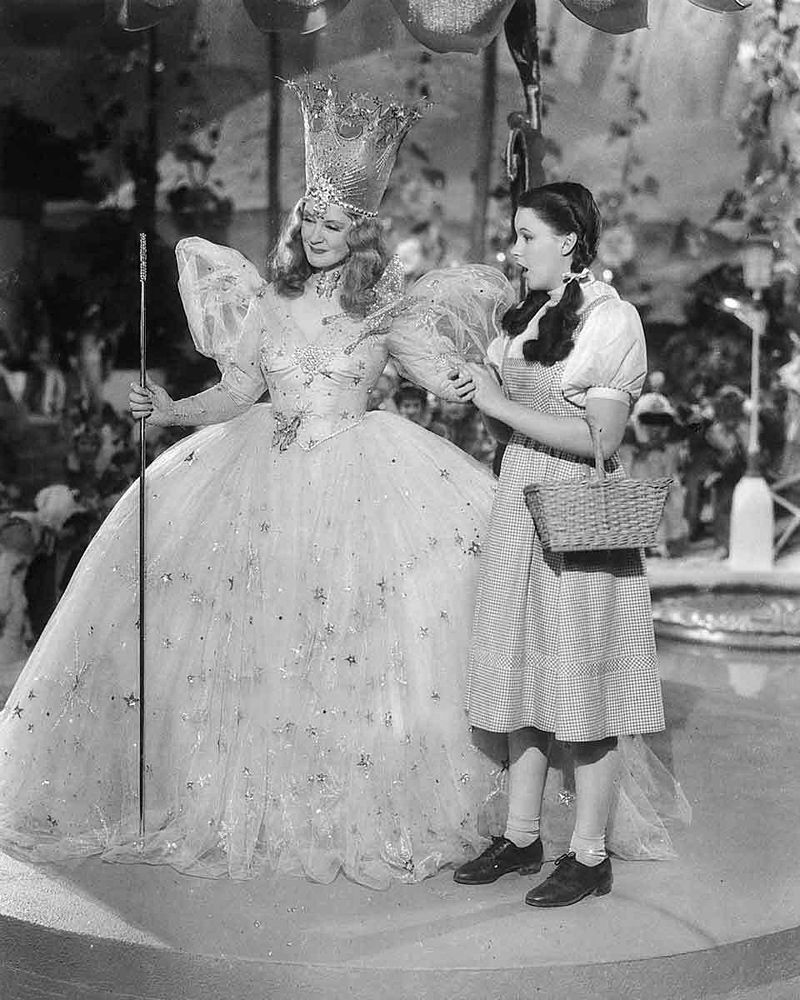
But if you’re a powerful witch in your own right, don’t you know that the wizard is a fraud? Of course you do, but the population having never seen a hot air balloon, has somehow deified him. Better to get this Dorothy girl to ask him for help and then discover the wizard is a fraud and reveal it to everyone—she doesn’t know anything about Oz politics. And if she’s already killed one witch, with the magical shoes she might kill another, right? It’s a gamble because what if she comes after you? Distraction.
You sprinkle the road (which, by the way explains why Glinda doesn’t just send her straight to the wizard in one of her bubbles) with misfits outside the power structure to help and even sober them up after the trippy poppy incident, but mostly you sit back. And it pays off. The wizard knew you sent the girl and gives her an impossible task of his own. A horrifying thought that some old man would send a child to retrieve a broom he had no use for. Anyway, she succeeds beyond your imaginings. The Wicked Witch of the West is dead (water, really?) and a breeze just happened to send the wizard off and away from Oz after he’d been outed (Does anyone really doubt Glinda made that man go?).
For your last bit of political maneuvering, you finally reveal that the girl can get home by clicking the heels (did that loosen them a touch?) and chanting about home. Who needs the savior of Oz sticking around? She clicks and chants and the shoes fall right off as she returns home. Now all Glinda has to worry about is that southern witch.
If you ask me, the real Wizard of Oz was Glinda.
The Mushroom Fairy
My last post I focused on the magic that I found traveling on the west coast. A comment from one of my readers who lives in the west coast made me think about how there are times that we forget how magical our own backyards can be.
My last post I focused on the magic that I found traveling on the west coast. A comment from one of my readers who lives in the west coast made me think about how there are times that we forget how magical our own backyards can be.
When I moved to my house over ten years ago, I walked my daughter to and from preschool. She's older now and walks herself, but I still enjoy walking in my neighborhood. Most especially I love seeing mushrooms. At this time of year they crop up everywhere and I can't resist taking pictures of them. Mushrooms are magical in my opinion--the colors, the shapes, the sizes, the suddenness--all of it is amazing and though I'm not a poet, it inspired me.
The Mushroom Fairy
She sets to work in the dampness of dusk
Arms laden with magic, air heavy with earthy musk
Soft soil delights in fairy tending
Seedlings thrive and ivy wending
By dawn all spells have been cast and thrice chanted
Greens, golds and grays securely planted
What sprouts are spongy clouds, an enchanted playground
Where fairies play and dreams abound
Travels through Faery
FF Readers, I recently did something that I haven't done in a long time. Or at least a long time for me. I went on a vacation. One of my favorite activities is traveling and the recent pandemic stopped that particular hobby. It felt wonderful to vacate the everyday and travel just for its sake. We took a road trip on the West Coast and I was pleasantly surprised to find little hints of the fey even there. I hope you don't mind me sharing some trip pics.
FF Readers, I recently did something that I haven't done in a long time. Or at least a long time for me. I went on a vacation. One of my favorite activities is traveling and the recent pandemic stopped that particular hobby. It felt wonderful to vacate the everyday and travel just for its sake. We took a road trip on the West Coast and I was pleasantly surprised to find little hints of the fey even there. I hope you don't mind me sharing some trip pics.


There's something about the shapes that trees make, which makes it impossible for me not to take a picture. I imagine ancient beings sentenced to eternal vigils or mages trading blood and bone for bark and roots in order to become immortal.


I have a thing for doors, but who says a door has to be a rectangle with a handle? I imagined these portals were doors to realms of earth, air, water and fire.


And of course, touches of whimsy. They add magic to the everyday.
What inspires you?
Liminal Lands
Are you a collector? I collect words. Hear me out. When I was little, I collected stickers and interesting rocks. When I got older I started collecting glass bottles. I’ve always collected journals and pens, but as any collector knows, collections need space. There comes a point when you must tell yourself the collection is finished. Not so with words!
Are you a collector? I collect words. Hear me out. When I was little, I collected stickers and interesting rocks. When I got older I started collecting glass bottles. I’ve always collected journals and pens, but as any collector knows, collections need space. There comes a point when you must tell yourself the collection is finished. Not so with words!
Words evoke and illustrate. In the right hands (or mouth) they can create whole words or destroy them. There’s power in words and potency in the right words. The same is true of a story, itself an intricate working of words.
So, when I found myself at a loss for the right words to complete this post, I decided to incorporate my love of stories and interesting words. Part of the joy of collections is occasionally trotting them out and remembering why you like them. Here's one of my favorites:
LIMINAL: adj. of, relating to, or situated at a sensory threshold
I can’t think of a more appropriate word to revisit for a blog based on fairy tales. It is said that fairies occupy the space between ours and the hereafter—the Liminal Lands. How else can fairies attain immortality?
The best example I have of the liminal is Rip Van Winkle who, in some versions of the story, falls asleep after drinking with mysterious men thought to be fairies and wakes 20 years later with a longer beard but otherwise unchanged. He slept in the liminal space and somehow went unnoticed.
Do you have any favorite liminal spaces?

Mechanical Creativity
As I'm sure you've noticed, new posts to my blog have been absent. I considered pushing through to make sure I had consistent content, but that's how I ended up in this predicament in the first place. Let me explain.
As I'm sure you've noticed, new posts to my blog have been absent. I considered pushing through to make sure I had consistent content, but that's how I ended up in this predicament in the first place. Let me explain.
When the pandemic first began, I was at the start of a blog tour promoting A Noble's Path, the next book in my quartet. While I had a wonderful time getting to know new bloggers and participating in interviews, the results were mixed. People had other things on their mind and so did I. We didn't know how long this whole thing was going to last and each day was a question mark.

After the tour ended, I threw myself into edits for book three, A Rebel's Path. And there were more than a few days when it felt like I had to throw myself into it because I had no desire to work on edits. I made a deal with myself that I would work on at least six pages every day, so I could get my manuscript to my editor in a timely fashion. I have no idea what I wrote and it showed when I got comments back from my editor saying, "This doesn't sound like you."
And it wasn't. I apologized to her and set my work aside promising to get it to her before summer. But the pandemic dragged on, my daughter was home "virtually learning" and my normal time for creativity became hampered. To make a long story short, I got stuck. So I made a really scary decision for someone who has written consistently since 2012. I stopped writing.
I knew it wasn't forever, but it still made me nervous. Why was I home, if not to commit to writing? Besides the quarantine, there was no reason I should be here. But then I started to embrace what I call mechanical creativity--artistic but guided. I practiced calligraphy drills. I used coloring books. I tried drawing tutorials. I created illuminated letter art for friends. I did a lot of redecorating in Animal Crossing. All of it had one thing in common--no writing and no stakes.


It's still scary especially because I have little patience. I want stuff done yesterday so I can check it off my list, but all the mechanical creativity has taught me to take a breath or three and realize writing will always be there. Every so often I have to relearn that.
So thank you for those readers who kept coming back to my blog and to the new arrivals, welcome. We finally seem to be on the approach to turn a corner and what better way to celebrate than getting back to normal-ish.
Second-Hand Stories
Myth: n. a traditional story serving to explain some phenomenon, custom, etc.
Mythology: n. the study of myths
Myth: n. a traditional story serving to explain some phenomenon, custom, etc.
Mythology: n. the study of myths
As the definitions suggest, myths help explain the unexplained. We all know that Greek myths were explained and at times mirrored by the Romans. We also know that the Romans were mythological magpies, that is to say whenever they encountered a new culture they had a habit of taking some of its mythology for their own. It helped that most cultures at the time were polytheistic and embraced a myriad of pantheons. Problems arose with the monotheistic traditions collided with the polytheistic, such as Judaism, because it challenged the idea of sharing pantheons. It also challenged the power of the priesthoods, but that’s not what this post is about.

When the reverse happened--monotheistic cultures coming into contact with polytheistic cultures in later centuries--it was notably messy. Whole civilizations were converted violently, and their traditions and stories were recorded by people who were at best dismissive of their ideas and at worst hostile. So, the stories we learned about Greek, Roman, Egyptian, or Norse mythology were told by the people who previously revered them. Indigenous cultures that were conquered by European powers rarely shared or passed down their beliefs. They shared them with a priest, who by profession couldn’t give credence to other mythologies. This is the problem I’m facing writing a Taino mythology book. My information is oral tradition given by an outside entity who barely respected the fact that they were documenting an endangered culture. What’s a writer to do? Read between the lines, I suppose and hope that I’m more sensitive to the responsibility of writing a second-hand story. Maybe knowing that I’m looking at these stories through a modern lens and acknowledging it is a start.
On the other hand, I'd like to think that at least part of the desire to write these stories and find new insights into them is being divinely inspired. A girl can dream!
Writers Don't Always Write
All this time at home should be a gift to a writer, but I’ve discovered the opposite is true. Inspiration comes from the outside world. A chance encounter with a stranger while waiting in a line. A funny mix-up with a cashier. Meeting a friend unexpectedly and remembering the time when…you get the picture.
All this time at home should be a gift to a writer, but I’ve discovered the opposite is true. Inspiration comes from the outside world. A chance encounter with a stranger while waiting in a line. A funny mix-up with a cashier. Meeting a friend unexpectedly and remembering the time when…you get the picture.
A pandemic is not the best time to have those moments. Zoom is too scheduled. Interactions with strangers are down to a minimum. And cashiers aren’t laughing right now. They’re scared and we’ve all been scared.
I know it’s made my writing suffer. I keep writing, but it’s more muscle-memory than elegant prose.
Maybe years from now a great novel about living during a pandemic will emerge, but right now it’s too new, too raw. In the meantime, what is a writer to do? My answer, so far, has been to try something new.
Dust off an old ambition. Polish up a moldering skill. Add something new to the lexicon. I always wanted to learn calligraphy. I’m still just a beginner but learning a new vocabulary and some history behind the art has given me a ton of new ideas for stories. I’m also taking a dance class and hope to add roller skating to my new bag of tricks.

Lots of books on writing will tell you that the best thing for a writer is to have a routine, sit at a desk and write every day. This time has taught me that the opposite is true. Change it up, get outside and remember there’s more to being a writer than writing.
Rain, Mattresses and a Pea
The Princess and the Pea is a story I’ve been thinking about lately. A woman appears one the prince’s doorstep on rainy night, drenched and claiming to be a princess. His mother, eager to marry off her son, conceives of a test where she puts a pea beneath a stack of mattresses and waits to see if the girl has a good night’s sleep or not. In the morning she’s told that the girl in fact had a terrible night because it felt like she was sleeping on a boulder. As proof, she shows the queen her back, which is completely bruised. The mother declares that she must be a princess because only a princess would feel a pea through all those mattresses.
The Princess and the Pea is a story I’ve been thinking about lately. A woman appears one the prince’s doorstep on rainy night, drenched and claiming to be a princess. His mother, eager to marry off her son, conceives of a test where she puts a pea beneath a stack of mattresses and waits to see if the girl has a good night’s sleep or not. In the morning she’s told that the girl in fact had a terrible night because it felt like she was sleeping on a boulder. As proof, she shows the queen her back, which is completely bruised. The mother declares that she must be a princess because only a princess would feel a pea through all those mattresses.
I used to read that story and think nothing of it. A girl proves she’s worthy by confounding the scheming mother’s ideas. But what does the prospective mother-in-law get or the prince for that matter? A girl who is so delicate she can’t sleep on cushy mattress if there’s a pea under one. That girl sounds soft to me. If I were the prince’s mother I’d put actual rocks under the mattress—just one—and pick the girl who woke up ready for the day despite tortured sleep. That girl can run a kingdom. Who wants their child’s partner falling to bits because of one pea? I'd want a princess who objects to mistreatment and knows her worth.
And what does the princess get? The prince wants to marry but continues to turn them down any perspective brides because he doesn’t think of them as true princesses. And yet, the one who’s the most sensitive is the one for him. What’s he like? What’s part two of this story? In an earlier post I wrote a little rhyme about it, but maybe next time I’ll write about what happens next. Any thoughts?

The Stories We Learn
In past posts I’ve mentioned my love of mythology. I knew more about Greek, Norse, Egyptian and Roman mythology than a child of eight should know. I loved the idea of goddesses and gods who were like us, but writ large. I didn’t know it then, but they were the original superheroes and arch villains. And I’m a sucker for a good origin story.
In past posts I’ve mentioned my love of mythology. I knew more about Greek, Norse, Egyptian and Roman mythology than a child of eight should know. I loved the idea of goddesses and gods who were like us, but writ large. I didn’t know it then, but they were the original superheroes and arch villains. And I’m a sucker for a good origin story.
Which is why I found myself becoming dismayed while researching my next project. I want to daughter and any future generations to know our mythology—Taino mythology and yet finding information about it proved difficult. I was equal to the challenge of reading academic research in Spanish (being both a historian and a Spanish speaker) and sifting through websites for what was honest conjecture and what was wishful thinking (my superpower is research). And yet the more stories I learned and loved, the angrier I became. Why hadn’t I learned more about this in school? I grew up in New York City, which is fairly progressive and well-represented by Puerto Ricans. Shouldn’t the indigenous cultures of the Caribbean have been covered? My love of Greek myths had started in school, why hadn’t my love been expanded to include my mythology? Why wasn’t my culture considered as interesting and vital? Eight-year-old me wouldn’t have known the answer, but current me knows the answer is obvious.
The stories we learn are important. It’s a recent idea that representation matters, but that’s an abstract idea. I’m reminded in little ways all the time that it’s more than an idea. It’s an ideal. And making sure the stories we learn include everyone is just as important as marches and rallies. Writers often say you should write the stories you want to see. I’ve always known I wanted to put Latinas at the forefront of my stories and I hope that one day a child of any background walks around with a big book of Taino myths and meets her new superheroes.
Three point cemi of the Tainos
Ravens, Writing Desks, and Series Writing
When I was little I used to watch certain videos over and over again. One of them was Disney’s Alice in Wonderland. My favorite part was the mad tea party. It looked like it would be a good time if you weren’t desperately trying to get home. I imagined drinking cups of tea, talking to the March Hare and the Mad Hatter and coming up with crazy riddles that no one could solve.
When I was little I used to watch certain videos over and over again. One of them was Disney’s Alice in Wonderland. My favorite part was the mad tea party. It looked like it would be a good time if you weren’t desperately trying to get home. I imagined drinking cups of tea, talking to the March Hare and the Mad Hatter and coming up with crazy riddles that no one could solve.
If you search for the answer to “Why is a raven like a writing desk?” on the internet, everyone has an answer. When I finally read Alice’s Adventures in Wonderland and Alice through the Looking Glass, I learned that the Mad Hatter didn’t know the answer either. In graduate school I wrote a paper on the mind of Charles Dodgson, aka Lewis Carroll. He was a mathematician who wrote the Alice books as a way to entertain the children of the Dean of Christ Church at Oxford. And it was written during the Victorian Era when the fanciful and the scientific were by turns at odds and in agreement. He admitted that many people wrote to him asking for the answer to the unanswered riddle.

“Enquiries have been so often addressed to me, as to whether any answer to the Hatter’s riddle can be imagined, that I may as well put on record here what seems to be a fairly appropriate answer, viz: ‘Because it can produce few notes, tho they are very flat; and it is never put with the wrong end in front!’ This, however, is merely an afterthought; the riddle, as originally invented, had no answer at all.” –Lewis Carroll
In other words, he wrote the question without having an answer. Sometimes when I’m struggling with edits for my series and feel inadequate when I have to refer to my notes or previous books to remember what one of my characters looks like, or where someone lives in relation to their mode of transportation, I think of Charles Dodgson and feel less frazzled. Series writing is like an unanswerable riddle—it’s open-ended, has tons of possibilities and relies on whoever is in front of it. Now back to the slog…
Oh, my favorite answer to the raven/writing desk question is neither is made of green cheese. It’s correct and absolutely ridiculous, which is what series writing can feel like sometimes.
New Year, Old Story
Readers, December was tough. Something about dealing with the holidays under the malaise of a pandemic and all the other issues that came along with it made it impossible for me to sit down and write posts. It was a struggle to finish my next round of edits, but I prioritized that and finished. Now just two or three more rounds to go…
Readers, December was tough. Something about dealing with the holidays under the malaise of a pandemic and all the other issues that came along with it made it impossible for me to sit down and write posts. It was a struggle to finish my next round of edits, but I prioritized that and finished. Now just two or three more rounds to go…
I know I’ve brought up Sleeping Beauty before, but the story seems right for so many occasions. Remembering to double-check your invitations. Being kept in the dark about a vital secret. Saved by a stranger, albeit creepily because he had to kiss you without permission. Learning to move on.

In this instance I was thinking about the bit players. The townspeople and the royal couple, elder edition. After being asleep for 100 years, how do you shake it off? For the townspeople, would you be angry that the king and queen’s oversight caused a major case of sleeping sickness? For the king and queen, do you atone, abdicate or maybe form a constitutional monarchy after the inevitable uprising from your subjects? And of course, for Sleeping Beauty: do you pack a bag and decide to brave the wide world you’ve been denied? I’d like to think all that happens. I’d like to think that the happily ever after really involves everyone becoming wiser and more mature after such a shared experience.
And that’s what I hope for this new year. May we all become wiser and more mature after such a shared experience.
Fairy Representation
A lot has been said and written about the drawbacks to revisiting the same stories over and over again. As a person who has written novels based on nursery rhymes and fairy tales, I prefer to look at story re-imaginings as a way to write myself and people like me into stories we've told for centuries. And I'm clearly not alone. Fairy tale retellings are very popular and for the very reason I described. The proof is Hallmark holiday movies.
A lot has been said and written about the drawbacks to revisiting the same stories over and over again. As a person who has written novels based on nursery rhymes and fairy tales, I prefer to look at story re-imaginings as a way to write myself and people like me into stories we've told for centuries. And I'm clearly not alone. Fairy tale retellings are very popular and for the very reason I described. The proof is Hallmark holiday movies.

I participated in a one-woman letter-writing campaign a few years ago. Every year I would compliment their programming and then ask them to consider making the characters more representative of the viewing audience. And over the years slowly (very slowly) but surely Hallmark has included people of color, movies about Hanukkah and this year, same-sex couples. A special thrill was seeing Julie Gonzalo, a not infrequent actress in Hallmark movies actually getting to play a Latina and her love interest was Black! I will admit that not all of them are great and some are downright bland, but it's sort of the point. Sleepy little rom-coms that normalize everyone's stories are just as important as mixed race and same-sex couples proliferating commercials.
Seeing yourself in a story gives it special significance and should never be discounted.
What stories do you want to see retold?
Fairy Support
This morning I woke up and yet again had to be reminded that a post is due. It was particularly difficult because I was finishing one of those books that makes you snarl at anyone who interrupts the experience. But the reading gave me my next post.
This morning I woke up and yet again had to be reminded that a post is due. It was particularly difficult because I was finishing one of those books that makes you snarl at anyone who interrupts the experience. But the reading gave me my next post.
First let me highly recommend Olivia Atwater. It is because of her books, Half a Soul and Ten Thousand Stitches, that I was again able to enjoy reading a book in one sitting. Her take on faerie tales is engaging and such a balm when escape is dearly needed. Nevertheless, I wasn’t just struck by her books, I was struck by her Afterword, something more readers (and writers) should pay attention to.
“The faerie godmother, I decided, was really the most admirable character in the whole story. She was the one, after all, who saw an injustice and tried to fix it.”—Olivia Atwater

I thought her assertion, that Cinderella’s story was really about a nobly born woman being returned to her rightful place was such a revelation that I’m almost embarrassed that it never occurred to me. On more than one occasion in fairy tales, the protagonist is a princess down on her luck and is then swept off to become a princess once more. Snow White and Sleeping Beauty are the ones that come to mind. Of course, Rapunzel and Belle from Beauty and the Beast have different stories, but in those the prince was cursed and therefore “understood” being powerless.
In the future I hope to use some of my posts to focus on modern fairy tale writers and their takes on what it means to rewrite time honored stories. In the meantime, check out https://oliviaatwater.com
Fairy Tale Issues
Readers, I’m supposed to post today, but for those who don’t know I am a US citizen and today is the Superbowl of politics for us (at least those of us who care about politics). It’s been on my mind for a while now and as such I’ve completely shirked my blog writing time. It wasn’t intentionally done, so you’ll have to forgive the slap-dash work.
Readers, I’m supposed to post today, but for those who don’t know I am a US citizen and today is the Superbowl of politics for us (at least those of us who care about politics). It’s been on my mind for a while now and as such I’ve completely shirked my blog writing time. It wasn’t intentionally done, so you’ll have to forgive the slap-dash work.
As I’m sure you’re aware, fairy tales don’t hold all the answers. There are aspects of life that aren’t covered by short stories about people who were inordinately concerned with predatory forest-dwelling animals as compared to the worries of the modern person. Politics is one of those blind spots. Most stories in fairy tales involve hereditary nobles. The stories would have to continue beyond the known endings of weddings and happily ever afters. I’d like to share some with you.
After having slept for 100 years along with her subjects, Sleeping Beauty understood the importance of universal health care and the peasants rejoiced.
The Simpleton from the Golden Goose, upon reflection, realized his good fortune was due to an act of selfless kindness and became known as The Benevolent King because he put the needs of his people before his own.
Snow White never returned to her own kingdom, but after marrying Prince Charming decided to challenge unconscious biases because how we look should never determine who we become.
The Valiant Little Tailor never meant to reach the throne on the power of one lie and therefore poured resources into trades, like haberdashery, that included education and allowed for upward mobility if ever that trade became defunct.
Cinderella, ever mindful of her treatment at the hands of her wicked stepmother, opened shelters throughout her kingdom for abused girls and boys to feel safe and find fulfilling lives. (She partnered with the Valiant Little Tailor)
Rapunzel never forgot her ordeal, especially being locked away and then exiled with no skills to raise twins as a single-mother, and therefore started programs for universal daycare paid for by the crown to assist single parents get on their feet.
Little Red Riding Hood didn’t have a kingdom, but she became a fearless advocate for women’s rights (especially the right to walk unescorted without fear of being attacked) and senior care in honor of her Grannie.
These are just a few of the many intuitive leaps I’ve made after reading a fairy tale. I haven’t even mentioned affordable housing with the Three Little Pigs, immigration and the Frog Prince, or…you get the picture. Here's hoping that all our favorite fairy tale characters remembered their hardships and worked to improve the lives of others now that they were in better positions. And may we all do that whenever possible.

If you're in the US--remember to vote!
Simple Pleasures (other than fairy)
I remember being 13 and pretending to be sick to stay home from middle school. I’m pretty sure my mother knew I wasn’t sick, but I was a good student, so she allowed the deception. And I used the day to read a book from cover to cover (another likely reason she let me stay home). It was delightfully decadent made all the more so because the book in question was Forever by Judy Blume.
I remember being 13 and pretending to be sick to stay home from middle school. I’m pretty sure my mother knew I wasn’t sick, but I was a good student, so she allowed the deception. And I used the day to read a book from cover to cover (another likely reason she let me stay home). It was delightfully decadent made all the more so because the book in question was Forever by Judy Blume.
For those who don’t know, the book is about a girl who meets her first love, and they decide to have sex. What was amazing about the book was in no way a condemnation of teenage sex. The couple were fully consensual, and they were careful to use birth control and actually talked to a doctor. I won’t ruin the ending, but it was refreshingly real yet nonjudgmental. Even today I think it’s the best example of young love without being over the top or patronizing, but I’m not here to discuss the state of sex in young adult fiction.

I remembered that day because today I indulged in something I haven’t done in a really long time. Despite having myriad things to do on Monday, I bought a book and read it in one sitting. While the subject matter wasn’t as profound, it felt just as decadent to ignore (mostly) everything and read an entire book. 2020 has been a crazy year full of things that had to be given up for the greater good. I missed seeing family and friends as well as two big trips. I haven’t eaten in a restaurant since March and the usual visits to museums and seeing concerts are something I’m hoping will happen next year. But I also apprciate simple pleasures more.
Fairy Tale Billing Switch
Ever wonder how fairy tales get their titles? Some make perfect sense like Cinderella or Snow White, but how about Jack and the Beanstalk? I understand Jack, but how does the vegetation get higher billing than say, the Giant? Or what about Rumpelstiltskin? He might be pivotal, but the woman (who they didn’t bother to name) has way more lines.
Ever wonder how fairy tales get their titles? Some make perfect sense like Cinderella or Snow White, but how about Jack and the Beanstalk? I understand Jack, but how does the vegetation get higher billing than say, the Giant? Or what about Rumpelstiltskin? He might be pivotal, but the woman (who they didn’t bother to name) has way more lines.
In 7th grade I was enrolled in a performing arts middle school as a vocal music student. That year the drama department had students act out fairy tales. They had to write their own scripts, block movement, etc. It was their end of the year project. My boyfriend at the time was the lead in The Golden Goose. No, he wasn’t the goose, he was the simpleton who, after having read the story myself, seems to be simple only the sense that he was kind enough to share his only food and drink to a stranger after his brothers said no. My post isn’t about acts of kindness, although that could fill pages. It’s about a minor character—the princess.

After hilarity ensues with people trying to steal the simpleton’s golden goose, he comes to a kingdom where the king has declared that the man who can make his daughter laugh can have her as his wife. Modern feminism aside, the far-fetched notion is typical of fairy tales.
(Keep in mind we’ve accepted a tailor who killed flies can fell a giant, a woman who has been kept in servitude only gets a reprieve when she asks for a dress to dance at a ball, and a small man who spins straw into gold thinks a first born is appropriate compensation for services rendered.)
No, what gets me is the fact that the princess wasn’t laughing until a man trailed by greedy people trying to grab a golden goose fell in front of her. What was going on in the kingdom? Was her home life bad? I assumed all sorts of things considering her father was willing to bargain her away if someone could make her chuckle. What did she suffer from? Personally, I think that’s the more interesting story. If anyone deserves a backstory, it’s the princess from the Golden Goose, a story that gives top billing to the MacGuffin.
Are there any fairy tales you've read where you wanted to know more about a secondary character? Do you wonder what kind of life the Giant lived before Jack pilfered his stuff? Why did we follow the spoiled princess who was forced to keep her promise to the frog when faithful Henry, his servant was the one who really loved him?
Lost in the World of Faery
Before the Victorians made fairies cute and cuddly, they were naughty and dangerous. It was said they would whisk a person away to dance at their court for what seemed like an afternoon and yet years would pass in the mortal realm.
Before the Victorians made fairies cute and cuddly, they were naughty and dangerous. It was said they would whisk a person away to dance at their court for what seemed like an afternoon and yet years would pass in the mortal realm.
That’s how I feel these days. Like I’ve been taken away to an alternate universe where time has little meaning until someone reminds me that something is due or needs to be done. It’s why I’ve been late posting this. I’ve been lost in the world of faery.
My time “there” got me thinking about time. On more than one occasion I’ve said to family and friends that time is a construct in a tongue-in-cheek sort of way. But is it wrong? We construct it for ourselves—personal hallmarks to tell us what comes next. This time of year, I expect the start of the new school year, cooler weather and longer walks. Now that one of those three things hasn’t happened, my natural writer’s clock is sluggish.
This is all a long way of saying I’m taking the month of September off from my blog. I need to get back in a rhythm and I feel my time with the fairies isn’t yet over.

Minding my Mythology, part II
Here’s the problem when mythology is collected from an interrupted culture: the stories are left partially incomplete. The Greeks thrived for centuries recording their mythology for posterity in a written language. It proliferated throughout the ancient world allowing it to become further etched in the culture. Even after the arrival of Christianity there were folk beliefs that remained.
Here’s the problem when mythology is collected from an interrupted culture: the stories are left partially incomplete. The Greeks thrived for centuries recording their mythology for posterity in a written language. It proliferated throughout the ancient world allowing it to become further etched in the culture. Even after the arrival of Christianity there were folk beliefs that remained.
The Tainos didn’t have a written language and relied primarily on oral tradition. As such their beliefs were dictated to one priest who came with his own biases while being the chronicler of a culture that would almost disappear. As such some of his writings have to be interpreted and have been, by men.
All this preamble is to explain that the following story from Taino mythology is based on the research I’ve done and inference based on the contradictions and gaps I’ve found.

Old Blood Mother
Much has been said about the Four Twins and especially the first among her quadruplets, Deminán Caracaracol. But what of the woman who brought them into being?
The gods tried many times to coax beings from the underwold that could inherit the Surface. Their attempts brough forth creatures that were ill-suited to the bright rays of the implacable Sun. And yet they knew one day men and women would populate the earth. It would require someone of great bravery and selflessness.
Her name was Itiba Cahubaba.
Itiba Cahubaba wandered the world of the gods largely ignored by them. She, along with others of her kind, eked out an existence from the remnants left by their creators. How she became pregnant remained a mystery, but she sensed that pregnancy was important to her people.
Her stomach grew and grew although the rest of her became thin and weak. Despite this, she when to great lengths to protect her belly knowing she had to successfully give birth.
Finally, the day came when the pains assailed her. She worked hard, but she quickly grew too tired to continue. When others of her kind came, she made them promise that her child would be born, no matter the cost. They agreed and as she lay dying one of them used a stone axe to open her belly. To everyone’s shock, not one but four children were born.
Because of Itiba Cahubaba’s sacrifice her people came together ending their nomadic existence. Recognizing her willingness to give her life’s blood to further her race, they honored her as an ancestral spirit, the Old Blood Mother.
Minding my Mythology, part I
I’ve mentioned once or twice that my superpower is research. It’s also my comfort zone and in these unsettling times, research is where I go to relax. Lately it’s been mythology. As a child, I devoured books about Greek and Egyptian mythology. And yet I never thought to search for my own.
I’ve mentioned once or twice that my superpower is research. It’s also my comfort zone and in these unsettling times, research is where I go to relax. Lately it’s been mythology. As a child, I devoured books about Greek and Egyptian mythology. And yet I never thought to search for my own. In a previous post, I mentioned the need to invite other pantheons to the table and I’m gratified to see Yoruba, Hindu, Korean, Mayan and many other mythologies are getting their day in the sun thanks to Rick Riordan.But I want to do my part, too. My research has led me to finally fulfill my 2014 promise in the post At the Crossroads of Fairy Tales and Folklore and learn more about my own mythology.The indigenous people of Puerto Rico (Borinquen) were the Tainos. They had a rich culture and an intricate mythos. Here’s one story:Yaya was the Original Spirit, imbued with both feminine and masculine energy. Being of both natures Yaya was able to conceive a son, Yayael. At first, Yayael was an obedient son, doing as Yaya told him. Yet as he grew, a rebellious streak grew with him. He was envious of his creator’s power and position and began to plan Yaya’s murder.![[photo of the Zemi stone]](http://www.hartford-hwp.com/Taino/photos/zemi.png) But Yaya was observant and sent Yayael away, hoping that it would change Yayael’s feelings. When Yayael returned, his feelings hadn’t changed, and Yaya had no choice but to kill Yayael. Suffering the loss of a son, Yaya collected Yayael’s bones and put them in a calabaza, a gourd, and hung them from the roof the house. Days passed and Yaya missed Yayael and they brought down the calabaza to look at their son's remains. To their astonishment, the calabaza was filled with water and the bones had become fish of all kinds. Yaya ate the fish, but there were always more. After eating their fill, Yaya put the calabaza back on top of the house……To be continued!
But Yaya was observant and sent Yayael away, hoping that it would change Yayael’s feelings. When Yayael returned, his feelings hadn’t changed, and Yaya had no choice but to kill Yayael. Suffering the loss of a son, Yaya collected Yayael’s bones and put them in a calabaza, a gourd, and hung them from the roof the house. Days passed and Yaya missed Yayael and they brought down the calabaza to look at their son's remains. To their astonishment, the calabaza was filled with water and the bones had become fish of all kinds. Yaya ate the fish, but there were always more. After eating their fill, Yaya put the calabaza back on top of the house……To be continued!


Never miss a new post
Subscribe to the Fairy Tale Feminista