
The Fairy Tale Feminista
Answering life’s questions one fairy tale at a time.
Food & Fairy Tales
With Thanksgiving just around the corner, I started to think about the relationship of food and fairy tales. Just a cursory look is a mixed bag. Food is a weapon, a threat, transportation, or an opportunity to change your life, just to name a few.
In Snow White, the evil queen’s last-ditch effort to rid herself of her stepdaughter is an apple. A poisoned apple. Hansel and Gretel is probably the scariest of the food references. After being abandoned by their father and mother, they come to a home made of candy and gingerbread only to be trapped by the witch inside who eats children!
With Thanksgiving just around the corner, I started to think about the relationship of food and fairy tales. Just a cursory look is a mixed bag. Food is a weapon, a threat, transportation, or an opportunity to change your life, just to name a few.
In Snow White, the evil queen’s last-ditch effort to rid herself of her stepdaughter is an apple. A poisoned apple. Hansel and Gretel is probably the scariest of the food references. After being abandoned by their father and mother, they come to a home made of candy and gingerbread only to be trapped by the witch inside who eats children!

Cinderella needed a way to get to the prince’s ball and her fairy godmother created a carriage from a golden pumpkin. She also makes footmen and coachmen from various crawling animals. (Who knew there were lizards in France?) The Golden Goose never would have happened if Dummling (the youngest son) hadn’t shared his burnt biscuit and soured ale with a stranger, who used magic to improve the meal and find a gold egg laying goose for the generous young man.

So what do we learn about food in fairy tales? Strangers offering food are suspect, but strangers willing to share your food might be magical. Gourds aren’t just for pie or cornucopias. And never, ever, eat someone’s house without expecting a hefty bill. Don’t know if these are rules to live by, but they’re a good starting point.
Happy Thanksgiving!

Summer Shorts #4: Humpty Dumpty is not an egg
Here’s a random thought: why do we think Humpty Dumpty is an egg man? If you just read the words, he could be anything or anyone that falls from a great height and then can’t be fixed. In fact, the identity of the unfortunate character has been discussed since it was first written. For some, it was posed as a riddle instead of a poem. Another possibility is that Humpty Dumpty was a drink of brandy boiled with ale. In which case, couldn’t Humpty Dumpty be a bottle of liquor?
Here’s a random thought: why do we think Humpty Dumpty is an egg man? If you just read the words, he could be anything or anyone that falls from a great height and then can’t be fixed. In fact, the identity of the unfortunate character has been discussed since it was first written. For some, it was posed as a riddle instead of a poem. Another possibility is that Humpty Dumpty was a drink of brandy boiled with ale. In which case, couldn’t Humpty Dumpty be a bottle of liquor?

What do you think Humpty Dumpty could be?
Summer Short #3: The Pied Piper of Marketing
Marketing is something I find daunting and frankly a little boring. You spend time, effort, and sometimes money and then send it out into the world without knowing if it will make a dent. In order to get noticed you have to be either consistent or splashy. The part where I think it’s boring makes consistency tricky and being splashy is just as tricky when it tends to be outrageous.
Marketing is something I find daunting and frankly a little boring. You spend time, effort, and sometimes money and then send it out into the world without knowing if it will make a dent. In order to get noticed you have to be either consistent or splashy. The part where I think it’s boring makes consistency tricky and being splashy is just as tricky when it tends to be outrageous.
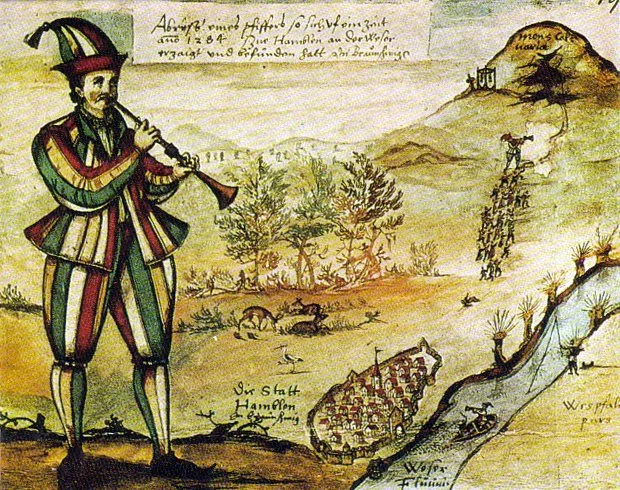
The oldest picture of the Pied Piper copied from the glass window of the Market Church in Hameln/Hamelin Germany (c.1300-1633).
It makes me think of the Pied Piper. His name comes from his clothing—pied means multicolored—and that’s how we know him. That and his magic pipe, which can lead rats and children anywhere he chooses. But I wonder, was the outfit just a marketing ploy to stand out from all the other rat catchers? He did get the job.
Finding my version of the Pied Piper for my books is my current challenge. Any ideas?
Modern Fairy Tale?
What makes a fairy tale modern? Does it have to be completely original? Is it a traditional story retold with modern sensibilities? Or is there a third option?
Original fairy tales are hard to come by, especially if you agree with the notion that only a set number of stories exist. There are days I believe that (like when I look at the movie landscape full of prequels, sequels and retellings). On good days I know there are new stories—or at least new to me. I haven’t read stories from all the cultures of the world and there are tons.
What makes a fairy tale modern? Does it have to be completely original? Is it a traditional story retold with modern sensibilities? Or is there a third option?
Original fairy tales are hard to come by, especially if you agree with the notion that only a set number of stories exist. There are days I believe that (like when I look at the movie landscape full of prequels, sequels and retellings). On good days I know there are new stories—or at least new to me. I haven’t read stories from all the cultures of the world and there are tons.
Retellings are very popular now. At least half the books in my TBR list are implicitly or explicitly retellings of well-known stories. I know Christmas just past, but my favorite retelling is any movie or TV show that uses A Christmas Carol as a framework.
My Top 3:
A Diva’s Christmas Carol: Love the Behind the Music as a stand-in for the Ghost of Christmas Yet to Come
A Mickey’s Christmas Carol: Great original song
A Muppets Christmas Carol: Piggy is my hero!
Honorable mention for Scrooged, but mostly for Carole Kane

I think a modern fairy tale is all those things—original, undiscovered, retooled and reformed by a deft author—and maybe something I still haven’t thought of yet.
Do you have a favorite modern fairy tale?
Does it Matter Where you Start?
Have you ever noticed that fairy tales don’t start with:
“Once upon a time a forlorn prince looked out his window and wondered if he’d ever find his true love…”
OR
“There was once a princess whose father decreed one day that her potential husband would be determined by a stranger’s ability to outwit a troublesome giant…”
Have you ever noticed that fairy tales don’t start with:
“Once upon a time a forlorn prince looked out his window and wondered if he’d ever find his true love…”
OR
“There was once a princess whose father decreed one day that her potential husband would be determined by a stranger’s ability to outwit a troublesome giant…”
Fairy tales are stories of the fantastical and nothing is more awe-inspiring than someone from lowly beginnings being given the keys to the castle—sometimes literally. They’re a come-up. Would Snow White be a fairy tale if she never left the castle? If Jack was the son of a successful merchant, would we root for him chopping down that beanstalk? I’m guessing not. Fairy tales need someone down on their luck to overcome impossible odds with a magical assist.

The notable exception is Red Riding Hood. Her circumstances are a complete unknown, but we can make assumptions about her background. She has enough money for a red cape—not cheap. Her mother has enough food to send extra to Red’s grandma. And said grandmother has her own place. But Red doesn’t get a prince or a castle. Does that mean it’s less a fairy tale and more a cautionary tale?
I suppose the question is can ordinariness be enough or do fairy tale characters have to be utterly wretched?
Inspired to Fairy Tale
Once upon a time there was a box. Within it was contained all the stories of the world. Stories of grit to stir the soul. Stories of ardor to touch the heart. Stories of humor to lighten the load. Stories of tension to quicken the pulse. But the box contained more than just stories.
Once upon a time there was a box. Within it was contained all the stories of the world. Stories of grit to stir the soul. Stories of ardor to touch the heart. Stories of humor to lighten the load. Stories of tension to quicken the pulse. But the box contained more than just stories.
It also contained secrets that inspired creativity and frustration. And sometimes, without warning, the stories disappeared.
Okay, that was my oblique way of describing TV or more specifically, TV shows that end on a cliffhanger and never come back. We’ve all had shows we invested in—let’s call one Pushing Daisies—and one day it just wasn’t there anymore. To be fair, it was after the first writers’ strike and a lot of shows vanished. However, that happens more and more lately. It’s almost like a plot point for a fairy tale.
One day an intrepid woman, maddened by the loss of yet another story found herself drawn to a wonderous thing—a blank notebook. With the lost story still humming in her head, she opened it and, armed with a pen, began to write. With her chosen weapons, she conjured fully formed beings and worlds well-trodden and newly discovered. The power of her imagination was able to do the impossible. She brought the stories back.
The moral of the story is fairy tales come from everywhere and anywhere. When you can’t find one—make one.
Plot Vs. Character, Fairy Edition
Plot Vs. Character—Fairy Edition
First, let’s address the elephant in the room…or the blog. I’ve been gone for a really long time. It wasn’t intentional, but it was with a good reason. I’ve been working on the last book in my Enchanted Path series and being a final book in a series, it’s become a bit of a bear. More on that in another post. This one is a question I’ve been asking myself while working through (seemingly) endless edits.
Plot Vs. Character—Fairy Edition
First, let’s address the elephant in the room…or the blog. I’ve been gone for a really long time. It wasn’t intentional, but it was with a good reason. I’ve been working on the last book in my Enchanted Path series and being a final book in a series, it’s become a bit of a bear. More on that in another post. This one is a question I’ve been asking myself while working through (seemingly) endless edits.
Plot or Character?
I know people who prefer a story that is character driven—where the plot is solely there to advance the development of the character—and like a deep dive into someone’s (or many someone’s) emotions.

Others prefer plot over character where the person (or persons) are a device through which the reader understands what’s happening. As a speculative fiction writer I tend to fall in the latter camp. I start a story with a problem or a situation and then I think about the best and worst people to deal with it.

The pitfall of character stories is sometimes nothing actually happens, at least not beyond the character’s mind. On the other hand, when plot of all important, a story can feel more like the Perils of Pauline, jumping from one disaster to another with people you barely know.
As the title of this post suggests, I wanted to look at this through a fairy tale lens. It shouldn’t come as a surprise that fairy tales are plot driven. Sometimes the characters don’t even have names, just titles or occupations. However, those stories are also very good at getting to the point of who the characters are and what they have to overcome. Cinderella is good and in a bad situation. The Wolf is bad and hungry.
Having that spelled out means we can focus on what happens to these characters. If we switched out these characters with other people, other things could happen. Red Riding Hood would likely neglect the chores Cinderella does in favor of exploring the woods. If the Giant from Jack and the Beanstalk were stomping about the woods, he’d likely have ignored the three little pigs or smashed all three houses without a second thought. So, characters do matter in plot driven stories.
Longer fairy tales can be character driven. Alice in Wonderland follows the adventures of one specific girl and her development from bored pupil to a queen. Would the story have taken the path it did if Alice had been Snow White or even an older Alice? A lot of the story depends on Alice being who she is at a particular time in her life.

I don’t know if any story can be called plot or character driven. A good story has both concepts playing with or against each other. Maybe it’s more a writer thing than a reader one. As a reader I hope to lose myself in a story with relatable characters and a plot that holds my interest. As a writer only one or the other starts a project.
How about you? Do you think character or plot is more important? Do you think there should be a distinction?
Just Say Fantasy
It's the end of Hispanic Heritage Month in the states and I have a confession to make.
I am a Latin American woman and I don't like magical realism.
It's the end of Hispanic Heritage Month in the states and I have a confession to make.
I am a Latin American woman and I don't like magical realism. It doesn't sound like a scandalous thing to say, but after reading my fair share of Marquez, Borges, Ortega y Gasset, etc. (in the original Spanish) I can soundly say I don't care for it. I also say this knowing how important a genre it has become for the Latino community. I can only speak for myself, but it's not uncommon for Latinos to believe in Catholicism and Paganism at the same time. We've been known to pray to God and also light candles to ancestors to intercede in daily affairs. We can hang a cross at one end of the house and a horseshoe at the other both to ward away the evil eye and negative spirits. Magical realism is a part of our lives.
So I don't mind the idea of magical realism. It's the "literarification" (an invention, I know) of it. I feel about it the same way I feel about Hawthorne. It's overblown and too descriptive with tragedy on every page. But that's not the worst of it. It's a pig with lipstick. Let me explain.
As I'm sure most readers of this blog know, I read fairy tales. I don't just read them for pleasure, but also to understand whether they still speak to a modern mind. For all intents and purposes, magical realism is just long form fairy tales. If you don't know, magical realism is when the fantastical is treated as normal in everyday life. What could be more in keeping with that genre than stories which include fairy godmothers arriving to help scullery maids attend royal balls or planting seeds from a stranger that become portals to a world of giants? And yet, magical realism goes on for pages and pages doing what folklorist can accomplish in 1,000 words or less.
Don't get me wrong. I don't object to length. I like weighty tomes with tons of world-building and fantasy settings. My problem is magical realists, literary magical realists, write what could be interesting fantasy stories, but because the idea of genre fiction is somehow less than worthy choose to add pretension.
That is not to say some people haven't done it well, usually with a lighter touch. These tend to be tagged as rom-coms or cozy fantasy. Or sometimes they work better as movies, such as Like Water for Chocolate, Amelie and Big. There are times I wish I liked it more--it seems like the perfect fit on paper--but being a reader who actually enjoyed the Shakespeare unit and F. Scott Fitzgerald among other literary classics, I've yet to find the literary magical realism book that didn't feel like work.

Maybe I haven't found the recommendation. Any to suggest?
Universal Fairy Tale Care
The other day my daughter said something that caught me completely off guard. We were watching A Tale Dark and Grimm on Netflix (which if you haven’t seen it, I highly recommend) and there was a reference to Rumpelstiltskin. She turned to me and asked who Rumpelstiltskin was.
Reader, I was flabbergasted!
The other day my daughter said something that caught me completely off guard. We were watching A Tale Dark and Grimm on Netflix (which if you haven’t seen it, I highly recommend) and there was a reference to Rumpelstiltskin. She turned to me and asked who Rumpelstiltskin was.
Reader, I was flabbergasted!
How could it be that my child didn’t know a seminal character from fairy tales? I remember reading the story, among others, to her when she was little. It was the story that started my Fairytale Feminista journey asking the question where fairy tales fit in modern storytelling and life. Where did I go wrong?
It really got me thinking about universality and storytelling. When I was a kid, my friends and I basically watched the same shows, read the same books, and went to the same movies. We had common reference points to communicate with each other. We all knew what it meant when you said, “I feel like Cinderella” or “I’m looking for my Prince Charming”. Now, everyone can have follow a sub-sub-genre of anything that caters to seemingly an audience of a hundred, a dozen, or even less. With all these “curated media experiences” we’ve lost something connective.
Don’t get me wrong. It’s wonderful and amazing that we’ve expanded the lexicon of storytelling by adding more people and experiences that were otherwise lacking (read: European and patriarchal to diverse in all senses of the word). I am happy that I finally see myself in some of my favorite genres. I also miss talking about a book I’m reading with friends and family because they’ve never heard of it.
What does this mean for something as arcane as fairy tales? Will their origins get lost or will the entire genre simply disappear? I know it’s not a dire threat, what with Disney and fairy tale retellings, but even that might one day lose its appeal.

In the meantime, I will continue to watch A Tale Dark and Grimm and fill in any gaps in what I consider a vital education for my daughter. Wish me luck!
Reader, do you think there are still universal stories or should we let go of that idea all together?
Pulling a Prince out of a Bear
As a reader, I love a good and well-considered plot twist. Depending on who you ask there are only six, seven, or thirty-six stories in the world. With that in mind, the only way to very them is with a good twist. Mind you I said a good twist. Too often I’ve been on the receiving end of a story that bends over backward to make a plot work with a twist so implausible it ruins it. There is such a thing as too twisty a plot and I say this as a person who reads fantasy and fairy tales. Even they get it wrong sometimes.
As a reader, I love a good and well-considered plot twist. Depending on who you ask there are only six, seven, or thirty-six stories in the world. With that in mind, the only way to very them is with a good twist. Mind you I said a good twist. Too often I’ve been on the receiving end of a story that bends over backward to make a plot work with a twist so implausible it ruins it. There is such a thing as too twisty a plot and I say this as a person who reads fantasy and fairy tales. Even they get it wrong sometimes.
Recently I read the story of Snow-White and Rose-Red, a story I always think I’ve read because of the Snow White angle. Now I realize why the latter was made into a movie and endlessly used for re-tellings and the former left to languish. In case you haven’t read it either:
Two sisters—Snow-White, the shy bookish one and Rose-Red, the lively, outspoken one—love one another and their mother. One winter day, a bear comes to the door and asks to warm himself by the fire. He and the girls become friends as he visits every day that winter. In the spring, he says he must go and protect his treasure from a bad dwarf. The girls encounter the dwarf many times over the spring and save him from small perils, but he’s never grateful for the help. The last time they meet with the dwarf and the bear, the dwarf begs for his life because the bear has threatened him. The dwarf tells the bear to eat the girls instead, but the bear kills him instead. Suddenly, the bear becomes a prince, explaining that the dwarf had cursed him. The prince marries Snow-White and Rose-Red marries his brother.

Leaving aside the fact that two sisters actually get along in a fairy tale (a twist worthy of the genre), there are so many elements that come out of nowhere that it’s hard to figure out what the point of the story is—be kind to strangers, even bears, that come to the door; always lend a hand even if the recipient is less than deserving; or is it the happily ever after with a prince. That last one works out well for Snow-White, but Rose-Red ends up married to the prince’s unknown brother. Why wasn’t he searching for ways to break his elder brother’s curse? Did he hire the dwarf? I think that’s the real story! I’ll likely have to write it myself.
Have you been blindsided by a plot twist?
Fairytale Retellings 2022
Before you ask, no that is not a typo and yes I am aware we are now in 2023. But the turning of the year was bumpy complete with an injury and a rather bad cold. Because of it, I got a slow start to all my work. But I’ll take a note from all the fairy tales I’ve read and know that how you start isn’t necessarily how you finish. In that spirit, I’m starting the year with a list, my list of fairytale-based reading from 2022
Before you ask, no that is not a typo and yes I am aware we are now in 2023. But the turning of the year was bumpy complete with an injury and a rather bad cold. Because of it, I got a slow start to all my work. But I’ll take a note from all the fairy tales I’ve read and know that how you start isn’t necessarily how you finish. In that spirit, I’m starting the year with a list, my list of fairytale-based reading from 2022
At the beginning of the year I read Shanna Swendson’s Fairy Tale trilogy. It’s a classic story in a modern setting about a woman who learns she and her sister are of the Fey and how that changes their lives. I don’t believe in spoilers, but I will say that although I loved this trilogy I know it was supposed to be longer. Some of the story for both sisters were left unresolved, which left me frustrated. As a writer I understand that life can get in the way when you have to finish a series, but as a reader my trust in a writer is broken when a story’s resolution isn’t addressed in a timely manner. And yet, I recommend all of them.

Toward the middle of the year I needed something lighter. I also have a tendency to read at least one Jane Austen retelling a year because I think of her novels as long form fairy tales. Somehow Maria Grace knew what I was looking for and as a bonus threw in dragons, my favorite cryptid. I made my way through the first three books of the Jane Austen’s Dragons series, but there are 11 so far. I intend to read each of them when I need a respite from my usual weightier reading. I think it’s important to have reading breaks while still finding a way to read and this fit the bill. And a special mention for the covers, which I loved!

My final reading was a continuation of a series I started the previous year. A Crown of Wishes was one of those books that I love and hate. I love them so much that I read them from cover to cover in an obscenely short amount of time, which I hate because the next book I read can’t possibly measure up. It’s based on Hindu mythology and is the second book in the world Roshani Chokshi created within that framework. It had everything I love in a book—mythology, a warrior woman protagonist, slow-burn romance, lots of magic and excellent writing.

I hope to have a list like this every year. Do you have any suggestions for this year? Do you have any go-to kinds of books? Happy 2023!
The List
Romantic comedies (and any romance genre for that matter) are our modern-day equivalent of fairy tales. At least the “girl-finds-a-prince or the boy-is-given-a-princess-type” fairy tale. It has a discernable formula—two people meet, they fall in love, an obstacle separates them (and according to Hallmark movies, that’s at the hour and thirty mark), and then all hurts are mended to a happily ever after conclusion—and often used devices. One of the most used is the List.
Romantic comedies (and any romance genre for that matter) are our modern-day equivalent of fairy tales. At least the “girl-finds-a-prince or the boy-is-given-a-princess-type” fairy tale. It has a discernable formula—two people meet, they fall in love, an obstacle separates them (and according to Hallmark movies, that’s at the hour and thirty mark), and then all hurts are mended to a happily ever after conclusion—and often used devices. One of the most used is the List.
You know what I’m talking about.
My first conscious awareness of it was as a kid watching When Harry Met Sally
One character, typically the guy, but I’ve seen some good lady lists too, enumerates all the reasons they can’t picture life without the other one. The one with the list always seems angry and frustrated to have to relate the list. The profess-ee stands, usually with tear-brightened eyes, in bewilderment. I’ve seen this done well and…not so well. Even so, I think it’s something that is glaringly absent from more traditional fairy tales.

Prince to Cinderella
“I think it’s adorable that cleaning products make you twitchy and you insist on going around barefoot.”
Prince Charming to Snow White
“No one eats apple pie quite like you.”
Prince to Rapunzel
“I love how grounded you are even though you live in a tower.”
If you’re thinking those aren’t really lists, you’re right. I think it’s what keeps the romance out of fairy tales. Relationships are transactional and haphazard. It's like marrying the firefighter who rescued you from a burning building when thanks (albeit profound) and maybe baked goods would do the trick. I suspect if either party were pressed for specifics about why they were together, the reasons would be unsatisfying.
Why do I bring this up? I suppose the breezy offerings at this time of year for books, movies, television and even music. Some tropes are admittedly overused, but some are as welcome as a cool breeze on a summer day. And it led me to wonder, where do fairy tales fit in? My conclusion: they don’t—at least not in a way that makes me want to use them as a romantic ideal.
Adult Rant
Maybe it’s the mom of a teenager talking, but I’m really tired of protagonists with lousy impulse control. It might also be the reason I’ve been actively seeking out books with adults. When I think about it Chosen One children or <gasp> teens would be a nightmare. Despite knowing nothing and adults actively trying to help them they have a psychotic need to “go it alone” or “try things out: at night, usually in a forest or a creepy basement.
Maybe it’s the mom of a teenager talking, but I’m really tired of protagonists with lousy impulse control. It might also be the reason I’ve been actively seeking out books with adults. When I think about it Chosen One children or <gasp> teens would be a nightmare. Despite knowing nothing and adults actively trying to help them they have a psychotic need to “go it alone” or “try things out: at night, usually in a forest or a creepy basement.

I understand the appeal, especially in speculative fiction. Powers have become a short-hand for hormones just as monstrousness or shifting has for puberty. I get it—lots of changes! But at the risk of sounding old—GET OVER IT. Too often it gives the protagonist carte blanche to treat everyone abominably after which the protag is forgiven in time to fix the mess mostly made by the protag.
For all I know fairy tale characters could have become just as tedious in the same way given the depth and breadth of a novel-length story. There is potential.
Jack’s larcenous proclivities could be the medieval equivalent of a teenage joyride in a stolen car.
Red Riding Hood’s deviation from the path, a stand-in for teen rebellion.
The boy in the Snow Queen who was infected by the evil mirror shards and ran away, analogous to runaways and drug use.
Still, I feel the need to rant. But maybe it’s just me. I know there’s a ton of people who love the snarky teen, whose only redeeming feature is saving the world. For me, it’s not enough. Do I ask for too much? Maybe.
But I’m a grown-ass adult.
Questions for the Queen
I’ve been in analysis mode with Snow White for some reason.
I’ve decided not to question it.
Ever think the mirror was messing with the queen? It was a fairy mirror and fairies are notoriously fickle and endlessly mischievous. Maybe they were tired of getting the same question over and over again.
I’ve been in analysis mode with Snow White for some reason.
I’ve decided not to question it.
Ever think the mirror was messing with the queen? It was a fairy mirror and fairies are notoriously fickle and endlessly mischievous. Maybe they were tired of getting the same question over and over again.
How many times do we have to tell this woman she’s pretty? Damn!
Either the mirror wanted to get in the queen’s head or there was some fairy-dwarf feud we mere mortals are unaware of.
And why kill the girl? Wouldn’t marring her perfection work just as well and easier to pass off as an accident?
“Oops, sorry you broke your nose falling down the stairs. Is that a scar?”
“Don’t worry, I cut my own hair all the time.”
Clearly being nice didn’t figure into the “fairest” bit if the mirror was already giving her rave reviews up until Snow started growing. And the story explicitly says the queen was vain. So, stooping to some mean girl tactics are less extreme when compared to her other homicidal tendencies.
What would you ask the queen?

First Three Things
Random thoughts are a given for most people. For writers they’re source material—the answer to the oft-asked question, “What inspired this story?” Here’s one of those stray thoughts that crept in during a sleepless night.
What were Snow White’s first thoughts when she woke up? Aside from the obvious—who’s this guy?
Random thoughts are a given for most people. For writers they’re source material—the answer to the oft-asked question, “What inspired this story?” Here’s one of those stray thoughts that crept in during a sleepless night.
What were Snow White’s first thoughts when she woke up? Aside from the obvious—who’s this guy?
“What’s your name?”
“Prince Charming. You?”
“Snow White, so at least we have one thing in common.”
“What’s that?”
“Our parents were crap with names.”
Also…
What’s the proper amount of gratitude? Can I get away with, ‘Thanks, I owe you a drink,’ should I ask my miner friends for a small cache of silver and gold for this guy, or is this one of those ‘I am forever in your debt’ deals?
We all know what she chose.
And there’s always a third thought. Was it for her stepmother? Did I really fall for another costume change? Was it for her lost kingdom? O.M.G. what’s the address? Or was it something completely random? Did I leave a pot on the stove before I DIED?
These are the kinds of thoughts that can keep a girl up at night!
What do you think her first three thoughts were?

To Warn or Not to Warn
To Warn or Not to Warn...that is the question.
One of the reasons we read fairy tales is to be transported in a predictable way. Yes, it’s all fantastical, but there are big neon sign type clues that tell you it’s coming. If you save a golden fish in a lake, you better believe it’s going to get you wishes. If a fairy godmother comes with a dress for the ball, you’re going to catch a prince’s eye. And if some rando takes your broken-down old cow and gives you beans, your garden is not getting basic wildflowers.
To Warn or Not to Warn...that is the question.
One of the reasons we read fairy tales is to be transported in a predictable way. Yes, it’s all fantastical, but there are big neon sign type clues that tell you it’s coming. If you save a golden fish in a lake, you better believe it’s going to get you wishes. If a fairy godmother comes with a dress for the ball, you’re going to catch a prince’s eye. And if some rando takes your broken-down old cow and gives you beans, your garden is not getting basic wildflowers.
But would you want to know that the story contains economic hardship, foot mutilation or the dismemberment of a giant? Does it effect the experience? Admittedly fairy tales are rarely read once, so you already know what you’re getting by the first reread. I call that the Shakespeare clause. You don’t read Shakespeare for the ending—he lays that out at the beginning—you read it for the language and the twists of the plot. Unless it’s the histories, and then you already know what’s coming.
What if all you want is some surprise twists and turns? This is the Shyamalan clause. Once you know the ending, is there any point to watching the movie again? Maybe or maybe not.

This is all a long way of working out my feelings for book blurbs that tell the reader what to expect from the book explicitly. I don’t mean the “Will she save the world or lose her life?” descriptions. I mean the warnings. Lately I’ve seen a lot of addenda stating how steamy the romance will be or giving trigger warnings about violent acts. Is it really fair for the author to have to give these kinds of descriptions for a potential reader? In the case of the trigger warning, I can see the desire to warn, but as to the heat levels for the romance—that feels like you don’t want to waste a reader’s time. And I think that’s where I struggle. Part of the reading experience is wasting time. After you finish school, any reading you choose to do is just that, a choice. I know we’re all super busy, but even the book I relegated to the DNF (did not finish) pile taught me something about my likes and dislikes. You look at the cover art, you read the back blurb, you skim the first few pages and then you take a chance. It’s relatively low risk, so why not leap? Reading is literally (and literarily) a pastime.
Jack didn’t hesitate at the bottom of that beanstalk, he just climbed.
As I said earlier, I’m on the fence. Blurbs can be misleading and then as a reader you feel cheated. I’m also the person who hates watching the Netflix trailers that give away the entire story and then I don’t watch because, why bother?
How about you? Do you want to know exactly what you’re getting when you open a book or is part of the adventure finding out as you go?
Running Through the Forest with Disney
As anyone who likes fairy tales knows, it is impossible to ignore the outsized influence of Disney. Many of the stories we think of as universal are really our collective watching of movies made by The Mouse. I personally have no problem with this because I love a good fairy tale re-telling (although I admit some are not that good) and my favorite is Robin Hood.
As anyone who likes fairy tales knows, it is impossible to ignore the outsized influence of Disney. Many of the stories we think of as universal are really our collective watching of movies made by The Mouse. I personally have no problem with this because I love a good fairy tale re-telling (although I admit some are not that good) and my favorite is Robin Hood.

I know what you’re thinking. Robin Hood is not a fairy tale. Well, you’re right. It’s a legend, which I like to think of as an older fairy tale. There is no magic, but the Disney version created whimsy by making all the characters animals. I think it’s an inspired touch that they made Robin a fox because of their popularity in fairy tales and fables as clever. My idea of an ideal guerilla army would have a fox at its head (not a mixed metaphor!), but that’s another post.
It was my first animated crush and my first love story. Robin Hood was dashing, brave and pined for Maid Marian, who he’d known since childhood. I didn’t care that the accents were all over the place (why was Allen-a-Dale a Texan, Friar Tuck and Little John from the Midwest, various characters from the American South and only Robin, Marian, Prince John, and Hiss from England?) or that the music was decidedly 70s folk. I just loved the pageantry, the adventure and the love story. And of course Lady Kluck, who was my secret hero and gave me hope that woman (even a chicken) can fight their own battles in a story.
I also attribute Disney’s Robin Hood for starting my interest in history, Anglophilia, and stories in general. All my favorite things came together in one animated package. I’m not even ashamed to admit that on nights I can’t sleep I often quote the entire movie and play it in my head from beginning to end! I saw other live action versions, but none compared to that first experience.
I’m not entirely sure why I wrote this post other than to say that when the world seems crazy and truly horrible things are happening, it’s hard to imagine that something as trivial as fairy tales are important. Stories matter. Taking walks through the forest, real or metaphorical, can lead to the unexpected—escapism or maybe a calling.
Did a story ever steer you toward something? A life choice? A career? A life-long love affair?
The Day After
Yesterday was Valentine’s Day (as if you didn’t know), the day dedicated to love. And though it’s supposed to be about all love, romantic love is arguably the most exciting, so it’s what we focus on. I’ve never been a fan of Valentine’s Day, but it doesn’t stop me from appreciating the symbols and gestures of the holiday. With one exception…
Yesterday was Valentine’s Day (as if you didn’t know), the day dedicated to love. And though it’s supposed to be about all love, romantic love is arguably the most exciting, so it’s what we focus on. I’ve never been a fan of Valentine’s Day, but it doesn’t stop me from appreciating the symbols and gestures of the holiday. With one exception…
Fairy tales are not romantic. I’m always baffled when people claim they want “the fairy tale.” With very few exceptions, fairy tales contain none of the hallmarks of romance. No meet-cutes, no long courtships, no enemies to friends (exception being Beauty and the Beast) and all the kissing happens when one of the party is unconscious. Not romantic!
And yet, we continue to look for our romantic ideals in fairy tales that were written in a time when romance was more about worship from afar, and becoming a couple was more about joining of property than joining of soulmates.
But I do believe in literary romance—Jane Austen comes to mind—just not in fairy tales. I just prefer my happily ever after’s to actually include love. Maybe we should change the saying to wanting the “Austen novel” or “fill-in-the-blank novel” (like Susanna Kearsley or Olivia Atwater).
Or (shameless plug) The Cemetery Circle!
What’s your favorite happily ever after?

A Winter Story, part II
Well, this is embarrassing…
A few weeks ago, I was scrambling for an idea. I’ve been remiss with my postings lately and I didn’t want another week to go by without putting something up. It’s not that I haven’t been writing—I’m in my (fingers-crossed) last couple of edit passes with my editor and outlining new projects—but when I’m in fiction mode, it’s hard to shift over to creative non-fiction. It’s what gave me my first idea.
Well, this is embarrassing…
A few weeks ago, I was scrambling for an idea. I’ve been remiss with my postings lately and I didn’t want another week to go by without putting something up. It’s not that I haven’t been writing—I’m in my (fingers-crossed) last couple of edit passes with my editor and outlining new projects—but when I’m in fiction mode, it’s hard to shift over to creative non-fiction. It’s what gave me my first idea.
I decided I would partake in an experiment and what is it they say about scientists who experiment on themselves? I wrote 100-word story without preparation, something I don’t do. I hoped, rather than believed, that I would come up with the next 100 words two weeks later in time for my next posting. Over a holiday! Two weeks came and went and nothing came to me.

It is a lesson I continually learn as a writer. I’ve had ideas for stories that were only atmospheric introductions with no plot ready, story endings with no idea how the beginning would work, and even names or single lines of dialogue I’ve loved with no story to call their own.
And that’s the gig. It’s not all writing jags and entire chapters that flow effortlessly, although there are those days too.
This was a very long way of saying I’m sorry for not finishing my story on time, but here’s what I have so far:
A Winter’s Story, part II
Bright light…
…filled the dark, cold house illuminating all the things the woman had collected over the years. In the blink of an eye, every item disappeared—all except the star light. Sitting next to the light was a girl, no bigger than a doll. The girl’s wide eyes took in the empty space for a long moment while the woman dropped down to the bare floor, her hands confirming what her eyes beheld.
“It’s all gone,” they said in unison, although the woman said it as a plaintive wail and the girl with gleeful awe.
Both woman and girl were right…
New Year, Old Story
Readers, December was tough. Something about dealing with the holidays under the malaise of a pandemic and all the other issues that came along with it made it impossible for me to sit down and write posts. It was a struggle to finish my next round of edits, but I prioritized that and finished. Now just two or three more rounds to go…
Readers, December was tough. Something about dealing with the holidays under the malaise of a pandemic and all the other issues that came along with it made it impossible for me to sit down and write posts. It was a struggle to finish my next round of edits, but I prioritized that and finished. Now just two or three more rounds to go…
I know I’ve brought up Sleeping Beauty before, but the story seems right for so many occasions. Remembering to double-check your invitations. Being kept in the dark about a vital secret. Saved by a stranger, albeit creepily because he had to kiss you without permission. Learning to move on.

In this instance I was thinking about the bit players. The townspeople and the royal couple, elder edition. After being asleep for 100 years, how do you shake it off? For the townspeople, would you be angry that the king and queen’s oversight caused a major case of sleeping sickness? For the king and queen, do you atone, abdicate or maybe form a constitutional monarchy after the inevitable uprising from your subjects? And of course, for Sleeping Beauty: do you pack a bag and decide to brave the wide world you’ve been denied? I’d like to think all that happens. I’d like to think that the happily ever after really involves everyone becoming wiser and more mature after such a shared experience.
And that’s what I hope for this new year. May we all become wiser and more mature after such a shared experience.

Never miss a new post
Subscribe to the Fairy Tale Feminista