
The Fairy Tale Feminista
Answering life’s questions one fairy tale at a time.
The First Story
While we have no concrete evidence, it’s safe to assume that the first story told was a warning from one homo sapien to another.
“Hey, in a time before now, I went in that direction with a hunting party and something with teeth and claws ate half of them. Be careful.”
While we have no concrete evidence, it’s safe to assume that the first story told was a warning from one homo sapien to another.
“Hey, in a time before now, I went in that direction with a hunting party and something with teeth and claws ate half of them. Be careful.”
But we are a race of curious adventurers. We’d have to be considering we saw things like lobsters, potatoes and prickly pears and said, “Let’s eat it.” So, of course whoever heard that story went in that very direction and confronted the clawed, toothed animal wanting to know what it was and if he, or she, could have a better outcome. We don’t know the end of that story, but we’re here so more than one somebody survived and continued the race.
Then what about fairy tales? More than a few are warning stories—be careful in the woods, stranger danger—but just as many, if not more, are about behavior. Would Cinderella have gotten a fairy godmother assist if she’d been pill? Could Jack have gotten away with the golden goose and magic harp if he hadn’t done a good turn for a stranger and had a hungry mother at home?
Image by Gordon Johnson from Pixabay
Fairy tales warn and assure us that virtuous behavior will, eventually, be rewarded. It also gives hope to people in dire circumstances that anyone can change their fortunes (and maybe become royalty). It’s an idea that gives me comfort when the world isn’t friendly.
Does it Matter Where you Start?
Have you ever noticed that fairy tales don’t start with:
“Once upon a time a forlorn prince looked out his window and wondered if he’d ever find his true love…”
OR
“There was once a princess whose father decreed one day that her potential husband would be determined by a stranger’s ability to outwit a troublesome giant…”
Have you ever noticed that fairy tales don’t start with:
“Once upon a time a forlorn prince looked out his window and wondered if he’d ever find his true love…”
OR
“There was once a princess whose father decreed one day that her potential husband would be determined by a stranger’s ability to outwit a troublesome giant…”
Fairy tales are stories of the fantastical and nothing is more awe-inspiring than someone from lowly beginnings being given the keys to the castle—sometimes literally. They’re a come-up. Would Snow White be a fairy tale if she never left the castle? If Jack was the son of a successful merchant, would we root for him chopping down that beanstalk? I’m guessing not. Fairy tales need someone down on their luck to overcome impossible odds with a magical assist.

The notable exception is Red Riding Hood. Her circumstances are a complete unknown, but we can make assumptions about her background. She has enough money for a red cape—not cheap. Her mother has enough food to send extra to Red’s grandma. And said grandmother has her own place. But Red doesn’t get a prince or a castle. Does that mean it’s less a fairy tale and more a cautionary tale?
I suppose the question is can ordinariness be enough or do fairy tale characters have to be utterly wretched?
To Warn or Not to Warn
To Warn or Not to Warn...that is the question.
One of the reasons we read fairy tales is to be transported in a predictable way. Yes, it’s all fantastical, but there are big neon sign type clues that tell you it’s coming. If you save a golden fish in a lake, you better believe it’s going to get you wishes. If a fairy godmother comes with a dress for the ball, you’re going to catch a prince’s eye. And if some rando takes your broken-down old cow and gives you beans, your garden is not getting basic wildflowers.
To Warn or Not to Warn...that is the question.
One of the reasons we read fairy tales is to be transported in a predictable way. Yes, it’s all fantastical, but there are big neon sign type clues that tell you it’s coming. If you save a golden fish in a lake, you better believe it’s going to get you wishes. If a fairy godmother comes with a dress for the ball, you’re going to catch a prince’s eye. And if some rando takes your broken-down old cow and gives you beans, your garden is not getting basic wildflowers.
But would you want to know that the story contains economic hardship, foot mutilation or the dismemberment of a giant? Does it effect the experience? Admittedly fairy tales are rarely read once, so you already know what you’re getting by the first reread. I call that the Shakespeare clause. You don’t read Shakespeare for the ending—he lays that out at the beginning—you read it for the language and the twists of the plot. Unless it’s the histories, and then you already know what’s coming.
What if all you want is some surprise twists and turns? This is the Shyamalan clause. Once you know the ending, is there any point to watching the movie again? Maybe or maybe not.

This is all a long way of working out my feelings for book blurbs that tell the reader what to expect from the book explicitly. I don’t mean the “Will she save the world or lose her life?” descriptions. I mean the warnings. Lately I’ve seen a lot of addenda stating how steamy the romance will be or giving trigger warnings about violent acts. Is it really fair for the author to have to give these kinds of descriptions for a potential reader? In the case of the trigger warning, I can see the desire to warn, but as to the heat levels for the romance—that feels like you don’t want to waste a reader’s time. And I think that’s where I struggle. Part of the reading experience is wasting time. After you finish school, any reading you choose to do is just that, a choice. I know we’re all super busy, but even the book I relegated to the DNF (did not finish) pile taught me something about my likes and dislikes. You look at the cover art, you read the back blurb, you skim the first few pages and then you take a chance. It’s relatively low risk, so why not leap? Reading is literally (and literarily) a pastime.
Jack didn’t hesitate at the bottom of that beanstalk, he just climbed.
As I said earlier, I’m on the fence. Blurbs can be misleading and then as a reader you feel cheated. I’m also the person who hates watching the Netflix trailers that give away the entire story and then I don’t watch because, why bother?
How about you? Do you want to know exactly what you’re getting when you open a book or is part of the adventure finding out as you go?
FTBC--Jack the Giant Killer
Here’s my earliest memory of Jack the Giant Killer: 

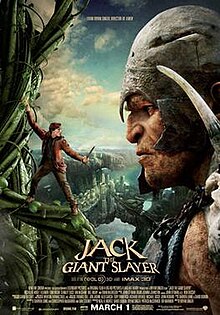
 Later, I saw the NBC miniseries of Jack and the Beanstalk: The Real Story starring Matthew Modine (2001). It was more of a re-telling, casting the original Jack, Modine’s something-great-grandfather, as a villain who stole from and killed the giant, Thunderdell, who was kind, if a little too trusting. I really loved this story because it was a true happy ending—Jack repents for his ancestor’s wrong-doing, peace and prosperity return to the kingdom in the clouds, and he and the very capable, independent “princess”, Ondine, live happily ever after.It wasn’t until much later in life did I realize that there was another story. A more gruesome story.The original story of Jack the Giant Killer has Jack killing at least six giants (or seven, depending on how you count two-headed giants). One three-headed giant is robbed by Jack and King Arthur’s son. The giant gives Jack gifts for sparing his castle (and him, presumably) because Jack’s reputation is becoming legendary in the giant community. The last giant he kills was to alleviate boredom and wins himself a duke’s daughter for a bride.As a rule, I try and find something to say about a story that relates to feminism or how it speaks to a modern reader. This story is too confusing to find anything in it. It borrows from so many stories, that were themselves popular, that reading it had me constantly stopping for odd moments of literary déjà vu. I can say the duke’s daughter is clearly an afterthought. There’s some Lady who isn’t given a name either and is under the thrall of Lucifer. Jack beheads him and then the Lady marries King Arthur’s son.Mostly, the Jack in Jack the Giant Killer comes across as some bro-dude who just likes killing giants. And clearly I wasn’t the only one who had a problem with the story and just said, “To heck with it,” and mixed Killer and Beanstalk.
  How about you, FF reader? Did this story leave you as confused as me?Come back next month, and we'll discuss The Golden Goose.See you then!
Ending the year going Into the Woods
I’ve never been one for the obvious. If it’s too easy, it’s boring. If everyone is doing it, something must be wrong. So there’s no reason I should like Into the Woods. It’s so blatantly a metaphor for a life lesson. You go through the woods naïve and afraid of the unknown only to emerge smarter and warier of the road ahead. Red Riding Hood learns about the dangers of straying from the path. Cinderella finds her voice. The baker realizes he’s not alone. Jack loses a friend but gains independence. Even writing these lines I want to yell “DUH” at the screen.But I love it. I love the music. I adore the Witch. The message is clever even while being obvious. When I saw the production as a kid I thought it was so cool that someone decided to mash all these fairy tales together. Now as an adult I’ve gained new insight into the lyrics. It’s an honest to goodness family movie mostly because you can watch it all your life and get something new each time. This time I learned about reluctance.We’re days away from the New Year and that means the dreaded list of resolutions. Last year I did away with the entire idea of it with the notion that making a list is just a way to make me feel bad by April (or March) because I’ve lost interest in them. My resolutions are usually related to moving more and exercise. Despite my best efforts, I am generally a sedentary creature preferring to read and write more than move and sweat.I searched fairy tales for a good story on reluctance, but I have yet to find one. Reluctant heroes are not a problem in fairy tales. Princes chase down maidens who gratefully accept the assistance. Tailors seek adventures on the basis of having downed seven flies with one hit. Little girls with bold outerwear head to Grandma’s without a thought for the hungry wolf that lies in wait. Reluctance is not something fairy tale characters are acquainted with.Except in Into the Woods. Only kids have no fear of the woods. Adults are very aware that the unknown could hold danger or at least disappointment. They’re all reluctant to enter, but they go because it’s the only way to get what they want. Hemming and hawing are allowed, but the woods are still waiting. Just like the New Year and my resolutions. So, I’ll make my resolutions yet again and work to get past May with them (at least).No more hemming and hawing…the woods await.
Happy 2015!
"Jack" and the Beanstalk
I think we can all agree that, on the whole, fairy tales try to teach us something about life. Usually there are warnings about the dangers of taking a dark path, talking to strangers, and not minding your elders. Others show how goodness can reap its own rewards and sometimes a castle and a title for your troubles. What about stories that do neither? I'm talking about Jack and the Beanstalk.There's some debate as to how old the story of Jack and the Beanstalk is, but the story pretty much stays the same. Jack and his mother are poor and their last asset, a milking cow, is no longer viable. Jack has to take the cow to market, but is met by a man along the way who offers him magic beans in exchange for his cow. Jack, for some reason, jumps at the chance and upon showing his prize to his mother is rebuked. She tosses them out the window in a huff, but by morning they have grown clear to the clouds. Jack climbs, finds a home and a sympathetic woman who feeds him and warns that her husband will come back hungry for the "blood of an Englishman". Jack, who is either clever or proof that God takes care of fools and babies, eludes the giant three times and steals his gold, his golden egg laying goose, and a self-playing harp. He then chops down the beanstalk killing the giant and lives with his mother happily ever after and rich.It's a great story, action-packed and complete with a happy ending, but what's the moral? If you're stupid enough to sell your cow for some magic beans you may luck into a fortune if you're willing to kill a giant? I've read and seen a few versions of this story. My favorite was the one with Matthew Modine called Jim Henson's Jack and the Beanstalk: The Real Story aired on NBC when it did mini-series before succumbing to the black hole that is cheap reality TV. It gave a plausible account as to why Jack did what he did and the repercussions of his actions. Of course I saw the Warner Bros. big screen adaptation, Jack the Giant Slayer, which was a slight disappointment. At the end when (spoiler alert!) the magical crown that controlled the evil giants was finally taken by the princess, she handed it over to Jack instead of using its power herself. This after an entire movie of her trying to prove that she could take care of herself. But it got me thinking, what if Jack had been female? Would it have turned out the same way? Is it true that women prefer diplomacy to violent confrontations? I would submit that there are few who actually like physical confrontations, but it seems more acceptable for women to take that path. Once there was a poor farmer who lived with his daughter. Her name was Jacqueline, but everyone knew her as Jack. Jack and her father only had one milking cow and very little else, but the day came when the cow no longer gave milk. Jack's father decided the best thing to do would be to sell the cow at market to a butcher and in that way have some food to eat for the winter. Jack loved the little cow, but her father was unmoved by her pleas. So with a heavy heart and a small snack for the road, Jack offered to take the cow herself so she might have a chance to bid the creature a proper goodbye.Along the way, she met with a man who looked even hungrier than her. Already feeling down about having to butcher the cow, she offered her meager lunch to the man. He gratefully sat down to eat and asked that she sit beside him. At length he finished the meal and then asked Jack why she looked so sad. Jack told the man the story of her cow and what had to be done to keep food on the table. The man considered a moment and said, "What if you didn't have to kill your cow and could still put food on your table?""I would say it's a miracle," replied Jack."Not a miracle. Magic. Magic beans to be more precise," corrected the man. He fished into his tattered pocket and pulled out four iridescent beans no bigger than a fingernail. He placed them in Jack's hand. "Now, although I am thankful you shared your meal with me, I cannot give these to you without payment. Magic unpaid costs more in the end.""But I have nothing to give you. I've told you I'm poor," reasoned Jack."Ah, but you have that nice cow. I promise she will not be killed or eaten, but to keep her alive and your stomach full you must give her to me in exchange for the beans," he replied. Jack was skeptical, but was heartsick over the thought of having to eat her friend, so she handed the lead over to the man. Looking down at the handful of beans, sparkling in the sunlight, Jack had only one question."How do they work?" But the man and the cow had disappeared. Jack saw that as proof of the man's magical claims and ran home, the beans clutched tightly in her hand...


Never miss a new post
Subscribe to the Fairy Tale Feminista