
The Fairy Tale Feminista
Answering life’s questions one fairy tale at a time.
FTBC--Jack the Giant Killer
Here’s my earliest memory of Jack the Giant Killer: 

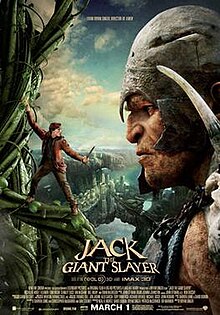
 Later, I saw the NBC miniseries of Jack and the Beanstalk: The Real Story starring Matthew Modine (2001). It was more of a re-telling, casting the original Jack, Modine’s something-great-grandfather, as a villain who stole from and killed the giant, Thunderdell, who was kind, if a little too trusting. I really loved this story because it was a true happy ending—Jack repents for his ancestor’s wrong-doing, peace and prosperity return to the kingdom in the clouds, and he and the very capable, independent “princess”, Ondine, live happily ever after.It wasn’t until much later in life did I realize that there was another story. A more gruesome story.The original story of Jack the Giant Killer has Jack killing at least six giants (or seven, depending on how you count two-headed giants). One three-headed giant is robbed by Jack and King Arthur’s son. The giant gives Jack gifts for sparing his castle (and him, presumably) because Jack’s reputation is becoming legendary in the giant community. The last giant he kills was to alleviate boredom and wins himself a duke’s daughter for a bride.As a rule, I try and find something to say about a story that relates to feminism or how it speaks to a modern reader. This story is too confusing to find anything in it. It borrows from so many stories, that were themselves popular, that reading it had me constantly stopping for odd moments of literary déjà vu. I can say the duke’s daughter is clearly an afterthought. There’s some Lady who isn’t given a name either and is under the thrall of Lucifer. Jack beheads him and then the Lady marries King Arthur’s son.Mostly, the Jack in Jack the Giant Killer comes across as some bro-dude who just likes killing giants. And clearly I wasn’t the only one who had a problem with the story and just said, “To heck with it,” and mixed Killer and Beanstalk.
  How about you, FF reader? Did this story leave you as confused as me?Come back next month, and we'll discuss The Golden Goose.See you then!
"Jack" and the Beanstalk
I think we can all agree that, on the whole, fairy tales try to teach us something about life. Usually there are warnings about the dangers of taking a dark path, talking to strangers, and not minding your elders. Others show how goodness can reap its own rewards and sometimes a castle and a title for your troubles. What about stories that do neither? I'm talking about Jack and the Beanstalk.There's some debate as to how old the story of Jack and the Beanstalk is, but the story pretty much stays the same. Jack and his mother are poor and their last asset, a milking cow, is no longer viable. Jack has to take the cow to market, but is met by a man along the way who offers him magic beans in exchange for his cow. Jack, for some reason, jumps at the chance and upon showing his prize to his mother is rebuked. She tosses them out the window in a huff, but by morning they have grown clear to the clouds. Jack climbs, finds a home and a sympathetic woman who feeds him and warns that her husband will come back hungry for the "blood of an Englishman". Jack, who is either clever or proof that God takes care of fools and babies, eludes the giant three times and steals his gold, his golden egg laying goose, and a self-playing harp. He then chops down the beanstalk killing the giant and lives with his mother happily ever after and rich.It's a great story, action-packed and complete with a happy ending, but what's the moral? If you're stupid enough to sell your cow for some magic beans you may luck into a fortune if you're willing to kill a giant? I've read and seen a few versions of this story. My favorite was the one with Matthew Modine called Jim Henson's Jack and the Beanstalk: The Real Story aired on NBC when it did mini-series before succumbing to the black hole that is cheap reality TV. It gave a plausible account as to why Jack did what he did and the repercussions of his actions. Of course I saw the Warner Bros. big screen adaptation, Jack the Giant Slayer, which was a slight disappointment. At the end when (spoiler alert!) the magical crown that controlled the evil giants was finally taken by the princess, she handed it over to Jack instead of using its power herself. This after an entire movie of her trying to prove that she could take care of herself. But it got me thinking, what if Jack had been female? Would it have turned out the same way? Is it true that women prefer diplomacy to violent confrontations? I would submit that there are few who actually like physical confrontations, but it seems more acceptable for women to take that path. Once there was a poor farmer who lived with his daughter. Her name was Jacqueline, but everyone knew her as Jack. Jack and her father only had one milking cow and very little else, but the day came when the cow no longer gave milk. Jack's father decided the best thing to do would be to sell the cow at market to a butcher and in that way have some food to eat for the winter. Jack loved the little cow, but her father was unmoved by her pleas. So with a heavy heart and a small snack for the road, Jack offered to take the cow herself so she might have a chance to bid the creature a proper goodbye.Along the way, she met with a man who looked even hungrier than her. Already feeling down about having to butcher the cow, she offered her meager lunch to the man. He gratefully sat down to eat and asked that she sit beside him. At length he finished the meal and then asked Jack why she looked so sad. Jack told the man the story of her cow and what had to be done to keep food on the table. The man considered a moment and said, "What if you didn't have to kill your cow and could still put food on your table?""I would say it's a miracle," replied Jack."Not a miracle. Magic. Magic beans to be more precise," corrected the man. He fished into his tattered pocket and pulled out four iridescent beans no bigger than a fingernail. He placed them in Jack's hand. "Now, although I am thankful you shared your meal with me, I cannot give these to you without payment. Magic unpaid costs more in the end.""But I have nothing to give you. I've told you I'm poor," reasoned Jack."Ah, but you have that nice cow. I promise she will not be killed or eaten, but to keep her alive and your stomach full you must give her to me in exchange for the beans," he replied. Jack was skeptical, but was heartsick over the thought of having to eat her friend, so she handed the lead over to the man. Looking down at the handful of beans, sparkling in the sunlight, Jack had only one question."How do they work?" But the man and the cow had disappeared. Jack saw that as proof of the man's magical claims and ran home, the beans clutched tightly in her hand...
Diversity Fantasy?
I remember being 4 or 5 and going to get my picture taken with Santa. My uncle took me and I didn’t want to stand in the Macy’s line, so we went elsewhere. I don’t think I was concerned with telling Santa what was on my list or even meeting the man, himself. All I knew was that I had on a cute outfit and would get my picture taken. After waiting in a line shorter than the one at Macy’s, I finally had my chance to indulge my vanity. But there was a problem. I had been lied to by my family.
We came home, my uncle and I, with a photo. In it, I was stiff and frowning. When my mother asked why I didn't smile, I promptly replied "Santa Claus no es negro. Santa Claus es blanco." My mother and other relatives who heard the story and saw the picture laughed to hear my explanation of how I didn't smile because the real Santa Claus is white. Inadvertently, I had stumbled upon an idea that led me to this post.

Later, when I was a little older, I played pretend with a friend. Snow White had just been re-released. It was as good a pretend game as any. It took a turn, however, when I said I wanted to play Snow White. My friend turned to me and without malice said “You can’t play Snow White. You’re not white.” I didn’t know what to say to that, but we moved on to some other game.
Put together, it just sounds like some funny anecdotes from my childhood, but I'm betting I wasn't the only one to have this experience. Despite myriad options to watch and read in fantasy, it has remained a rather uni-ethnic genre. Like Friends, uni-ethnic! I don't want to soapbox, but what's up with that?
Why in fantasy--where the limit is the entire spectrum of imagination--does the world look basically white?
There are exceptions--like BBC imports that practice colorblind casting—but very little to reflect all of us. Is it out of the realm of possibility for fantasy movies and TV to imagine a protagonist that isn't northern European? I know our collective consciousness is based on fairy tales and fables from Germany and England, but they were meant to reflect the public at large. Now that we embrace revisionist mythology, fractured fairy tales if you will, shouldn't we revamp the picture?
Rapunzel can be an African-American girl with super strong weave.
Jack the Giant Killer could be strong, brave, and gay.
Cinderella could be looking for the perfect pair of glass shoes to fit her size thirteen feet, supporting her plus-size frame.
Maybe Snow White could be Hispanic.
In that reality, maybe a girl would smile if she sat on Black Santa's lap.
I would love to hear from other readers and writers about diversity in fantasy. Have you seen a book, TV show or movie that reflects our new world geared towards teens or adults?


Never miss a new post
Subscribe to the Fairy Tale Feminista